Capture. Defend. Retake.
Foreign territory can be entered at the target country’s outer edge, then expanded through connected cells. Your original homeland can be retaken from any of its cells, subject to price and protection rules.
Choose your homeland. Join your country. Fight over a shared world map made of more than 100 million cells. Every border can change.
This isn't a single-player conquest. Every player who chooses the same homeland joins one team, sharing territory and fighting for the same borders. Defend what you have. Take what you can. Take it back when you lose it.
Territory is marked with the flag of the country controlling it. Track who holds each country and sector, then follow the standings as the map changes hands.
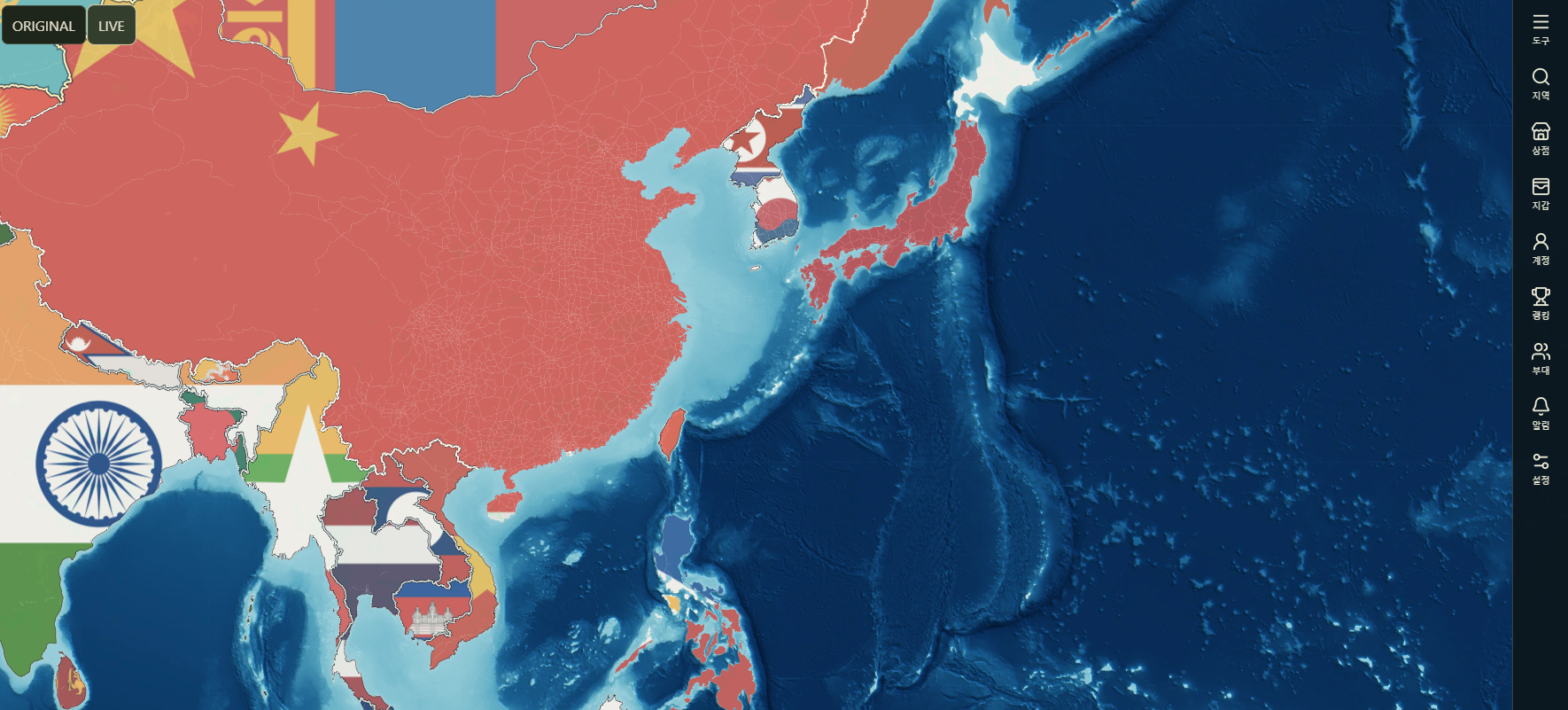
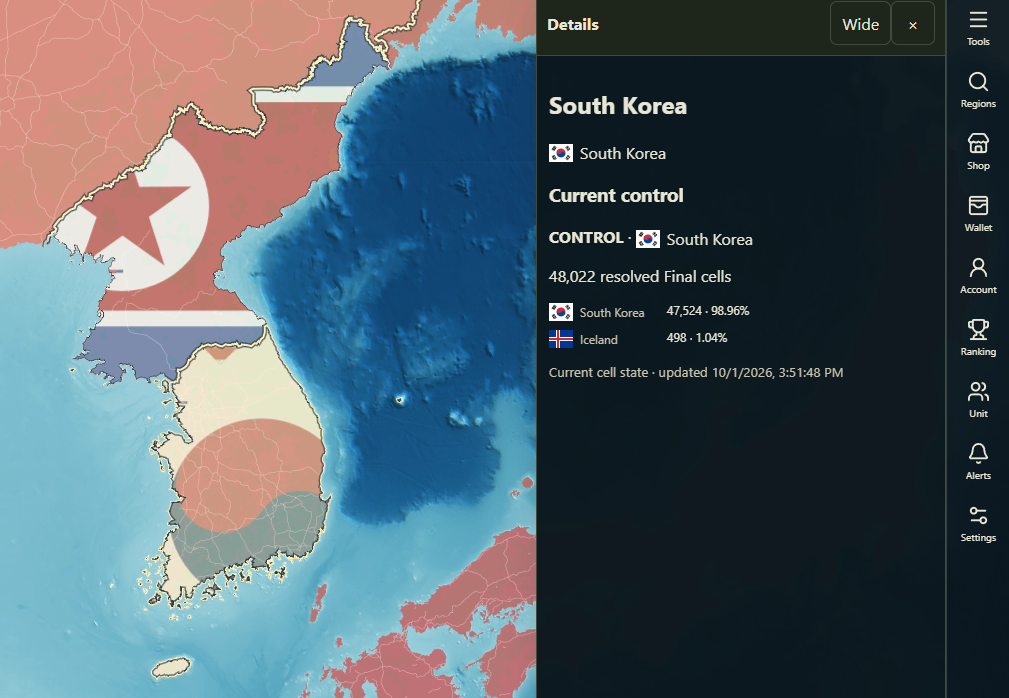
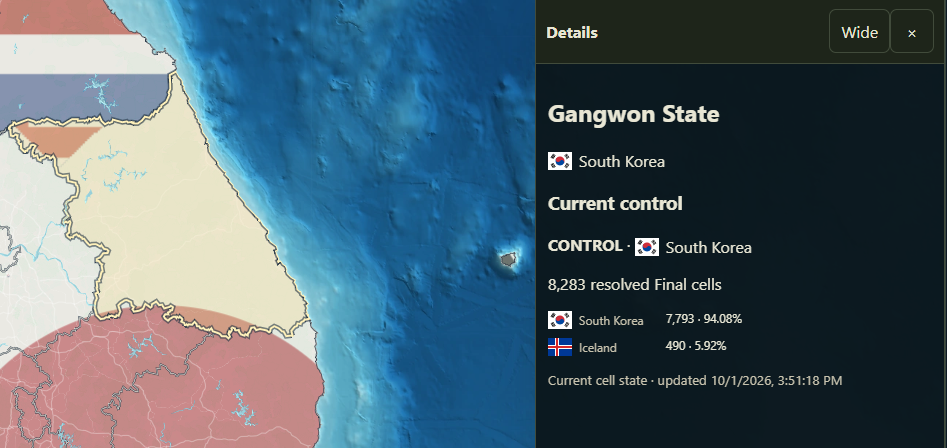
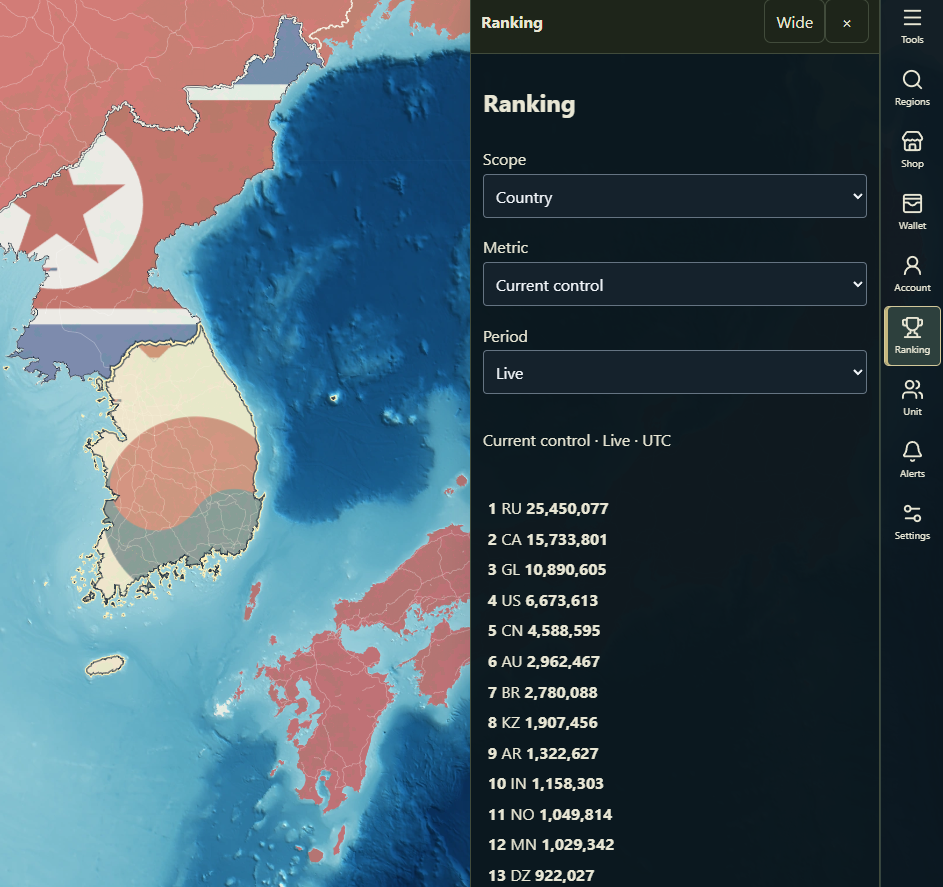
Screenshots are from a development build. UI, map presentation and game data may change before launch.
Foreign territory can be entered at the target country’s outer edge, then expanded through connected cells. Your original homeland can be retaken from any of its cells, subject to price and protection rules.
Cell capture uses Supply. After a valid capture, the cell is protected for 30 minutes. Then the next price depends on time since the last capture: under 24 hours, double the previous price (minimum 200); from 24 to under 72 hours, the previous price (minimum 200); from 72 hours onward, half the previous price (minimum 200). The initial price is 100 Supply.
Fronts are detected automatically from concentrated hostile capture activity over an area and time window—not simply because flags touch. They can intensify, move, merge and split. A Front reports the fighting; it does not itself grant capture rights or change prices.
Form Units with players from the same homeland. Players belong to one Unit at a time. Commanders coordinate Rally Points for advance and defense; those markers provide coordination, not automatic attacks or combat bonuses.
Pixel War is not only about territory. It also has player identity, unit coordination, progression and collection systems that shape how people participate in the war.
Customize your callsign, title plate, rank and personal presentation. Your profile is the public face of your participation in the war.
Each player belongs to at most one Unit from their homeland. The Unit has roles such as Commander, Officer and Member. Commanders manage Advance and Defense Rally Points; the Unit itself does not own land or receive combat bonuses.
Display emblems and visual identity markers so players and units can stand out inside the same national team.
Track country control, sector control and other standings to see which nations and players are rising as the map changes.
Player progress is recognized through Battle Ranks, medals and Front-related citations. Specific achievements and their conditions will be shown when the final interface is ready.
Place an approved personal Stamp on a cell you currently hold. You can change or remove it while you remain that cell’s holder; a Stamp is a territorial mark, not simply a collectible reward.
Every country is built from cells, sectors and country totals. Control changes are visible at every level, and the war follows a set of connected expansion and homeland rules.
Fronts are one of Pixel War’s key systems. They visualize where multiple countries are colliding, and they can grow, split or move as pressure changes. The game also separates exploration from action with distinct viewing and capture tools.
Fronts are automatically detected from concentrated hostile capture events within a time and geographic area. They can escalate through Live, Heavy and Critical states and may expand, move, merge or split. Friendly securing or mere border contact does not create a Front. Fronts visualize war activity; they do not grant extra capture rights, change price or attack automatically.
Explore Mode is for navigating the world without making purchases: inspect national borders, current control, country and sector details, histories and rankings. The exploration grid is kept out of the way.
Capture Mode enables cell selection and eligible purchases using the connected expansion and homeland reclaim rules. The capture grid appears at suitable zoom levels; purchases still respect current price and protection status.
All of the systems above will eventually be shown with dedicated screenshots or videos so players can understand the game before launch.
The initial cell price is 100 Supply. A successful capture protects the cell for 30 minutes. After that, the price follows time windows since the last valid capture: 30 minutes to under 24 hours = previous price ×2 (minimum 200); 24 to under 72 hours = previous price (minimum 200); 72 hours onward = previous price ÷2 (minimum 200).
Each cell has an ID, original country, controlling homeland, and capture history. Sector and country control percentages summarize changes in the original map.
Fronts are detected from clustered hostile captures. A front can grow, move, intensify, merge or split; its activity and lineage can be recorded. Its labels describe conflict rather than confer an advantage.
Official rules and actual Alpha behavior are being cross-checked before launch. Detailed figures and interfaces may be updated.
The war won't last forever. After the season ends, the final world map will be preserved online—a record of what every country, unit and player created together.
10% OF THE GAME'S NET PROCEEDS WILL BE DONATED.
Donation allocation and reporting details will be published before the game launches.
Pixel War is in development. We're fixing the last major issues before opening the world. Follow our progress and check back for the test announcement.
Official social channels will be linked here once verified.